


 Free Newsletter

Kenosha firm completes largest private affordable housing project in Wisconsin
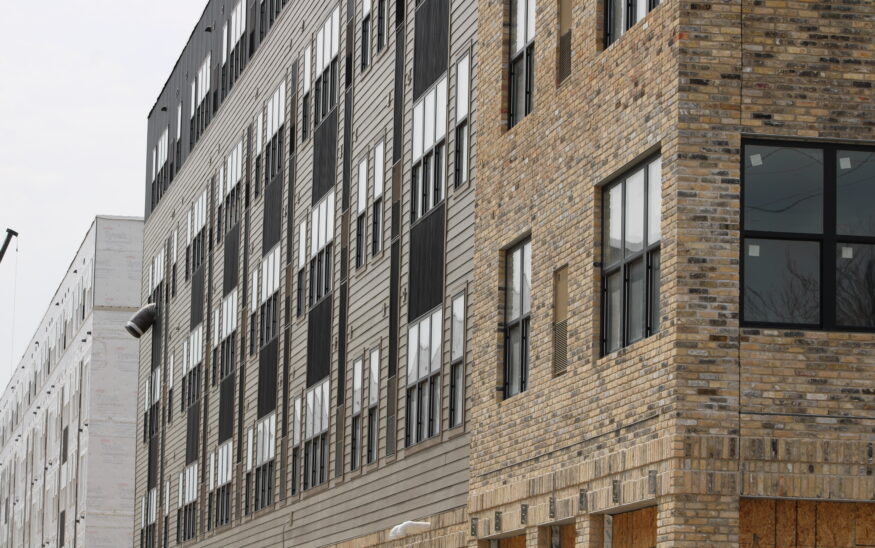
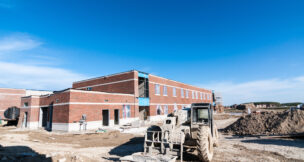
The Corliss in Milwaukee under construction in 2025. (Ethan Duran)
Kenosha firm completes largest private affordable housing project in Wisconsin
By: Wisconsin Public Radio//May 29, 2026//


 Listen to this article
By JOE TARR
Wisconsin Public Radio
This article originally appeared on Wisconsin Public Radio.
Kenosha-based Bear Development has done something unprecedented by building the largest private affordable housing development in the state.
When it is completed later this year, The Corliss in Milwaukee will provide 576 affordable housing units spanning eight buildings, including 144 units for seniors. The $197 million project involved a complex funding scenario that included National Housing Trust funds, tax incremental financing and a Brownfield Cleanup Revolving Loan from the city.
The complex funding arrangement reflects the reality of building affordable housing, said Elmer Moore Jr., the CEO of the Wisconsin Housing and Economic Development Authority.
“They are incredibly expensive (to build) at this point, with the supply chain labor costs and the cost of capital being just so high,” Moore told WPR’s “Wisconsin Today.” “The per unit cost reaches well into the hundreds of thousands, and when you multiply hundreds of thousands times nearly 600 you get to numbers that are truly astronomical.”
“It’s difficult for developers to secure the necessary capital, and it’s difficult for municipalities and other funders to arrange all the right approvals and necessary resources to make these kinds of deals happen,” Moore added.
Wisconsin, like most of the nation, desperately needs more housing, especially units that are affordable for working class families. A study from three years ago found the state needed 200,000 more housing units to meet demand by 2030.
Despite the challenges, Moore is optimistic that Wisconsin can build more housing of all kinds, including more affordable housing. He’s seeing local governments around the state doing more to attract developers.
“We’re seeing communities across the state really take a more proactive approach to making themselves accommodating to developments writ large, and certainly larger and larger developments,” Moore said. “But municipalities must develop zoning plans and housing plans that incorporate these large-scale developments and the amenities that they support — grocery stores, bike trails, changes to traffic and so on — because when we do that, we can really assure a clearer path towards success for that municipality.”
Getting financing is also becoming more difficult as interest rates climb. But Moore said that housing remains a good investment.
“There is very little risk investing in housing itself, because it is absolutely necessary. We are undersupplied by tens of thousands of units, even in just the Milwaukee area alone. The opportunity to generate a return offering debt to developers is a pretty safe bet, so long as the developer, like S.R. Mills and Bear Development, have a track record of delivering on their plans,” Moore said.
Local governments can help open up more capital for housing developments by also offering financial backing to leverage private investment.
“You see that in the form of housing funds, you see that in the form of TIF funds being directed towards housing developments,” Moore said. “It’s a safe bet for a community, and we’d love to assure more lenders and banking institutions around the idea that it’s a safe bet for their balance sheets as well.”
Large-scale developments are sometimes opposed by neighbors who worry that their homes will lose value. But S.R. Mills, the chief executive officer of Bear Development, said that didn’t happen with The Corliss.
Initially, the developer was looking at reusing some of the historic buildings on the site, which had been a Filer & Stowell manufacturing complex. But when saving the buildings became financially unviable, Mills said, the neighborhood supported moving ahead.
“What we heard was, (neighbors) wanted density, they wanted to create a neighborhood feel, wanted amenities such as the bike trail through the site, and to make sure it feels like the balance of the neighborhood,” Mills told “Wisconsin Today.” “As far as NIMBYism, we didn’t encounter much. It was more so just making sure it’s the right product for the area.”
Mills said that attitude is not unusual for urban areas “where there’s an appreciation for having great parks, having great outdoor space, but putting density where it is appropriate.”
“Where we run into more of the traditional NIMBYism is in some of the suburban and rural areas,” Mills added. “And while there’s many instances where we have great partners and neighbors there, usually there’s more of an education process about what we’re doing. Change can always be scary, but it isn’t bad and we just try and do our best to explain it.”
Related Articles

Related Content





Polls
 Loading ...
Today’s News
- Kenosha firm completes largest private affordable housing project in Wisconsin
- After federal DEI rollback, Wisconsin DBE recertifications plummet
- Milwaukee Tool plans 141,000-square-foot expansion in Menomonee Falls
- Wisconsin Pre-Bid Meetings – Week of June 1, 2026
- Milwaukee County investment helped bring Whitefish Bay development to life
- Milwaukee considers 12-story, 200-unit Harbor District apartment plans
- Wauwatosa students take next steps to ‘irreplaceable’ construction jobs
- Racine starts $130 million lead service line replacement project
- Federal court shelves lawsuit seeking to dismantle DBE program
- Oshkosh to buy City Center for $12.5 million
- Warehouse hoped to be hotel suffers fire in Milwaukee
- TOP BIDDERS: The biggest recent winning bids from around Wisconsin






Project Profiles
- First prefabricated bridge in US installed in Eau Claire County
- Illinois developer worked with Wisconsin contractor to build 258-unit Wauwatosa apartment complex
- VJS Construction raises the roof for Bruce Guadalupe Community School expansion project
- Microgrid pilot project will store energy for village affected by outages
- Dane County sees uptick in highway work zone crashes, on track to exceed last year
- The Hop streetcar will debut newest service route in fall with limited service
- FPC Live slims venue proposal to 1 downtown building
- Children’s Hospital urgent care center in Milwaukee gets first round of city approval
- With Sonag Construction shut down, feds move to block indicted owner from collecting leftover assets
- Four contractors selected to build border wall prototypes
- UW-Milwaukee’s Greenstreet shaping minds (and the city)
- Turning the Corner(s) (PHOTO SLIDESHOW)